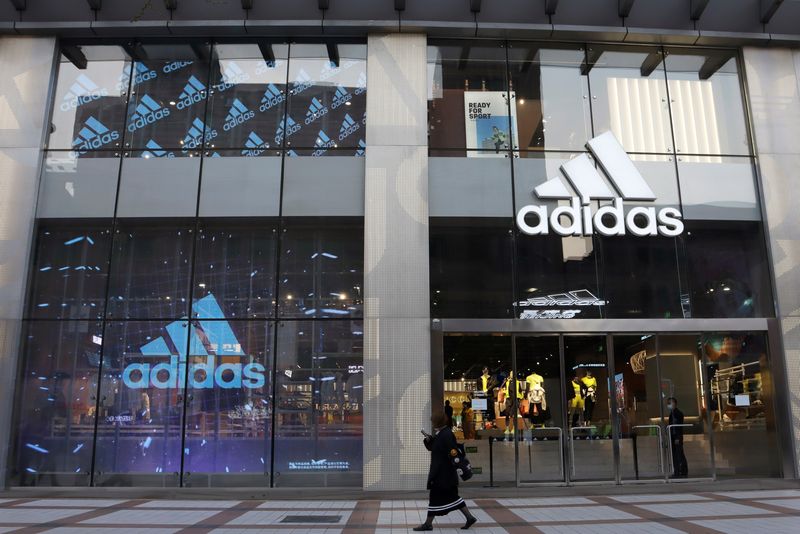
Adidas (OTC:ADDYY) forecast a lower than expected operating profit for 2025, anticipating sales growth will slow slightly from a strong 2024 which saw the last of its Yeezy sneakers sold.
Under CEO Bjorn Gulden, Germany’s Adidas, which has been gaining market share while main rival Nike (NYSE:NKE) struggles, has repeatedly delivered stronger results than it has forecast but the company’s shares fell 2.5% in a sign the cautious outlook disappointed the market.
Adidas said it should reach between 1.7 billion euros and 1.8 billion euros ($1.8 billion and $1.9 billion) operating profit in 2025, lower than the 2.1 billion euros analysts had expected.
Gulden, who has led a successful turnaround at Adidas since the end of its Yeezy collaboration with rapper Ye, struck an optimistic note but nodded to broader risks to consumer demand.
“Of course there is a lot of macroeconomic uncertainty right now, but with products that we think are on trend and the attitude of being agile and more local, I cannot see why we should not be successful,” he said in a statement.
Adidas expects annual revenues to increase at a “high single-digit” rate in currency-neutral terms, lower than the 12% growth it delivered last year, but sees growth of more than 10% when adjusting for the lack of Yeezy, after it sold its last remaining discontinued sneakers in the fourth quarter.
“A significantly better, broader, and deeper product range combined with an increased focus on local consumer preferences as well as much improved retailer relationships will be the main drivers of the projected top-line increase,” Adidas said in a statement.
In an annual report also published on Wednesday, Gulden said Adidas has a “clear ambition” of being the top sportswear brand in all markets except the United States – where Nike is especially dominant.
Adidas is looking for new sources of growth beyond its popular retro sneakers Samba and Gazelle, as it seeks to take further market share from Nike while also fending off newer sportswear brands, such as On Running and Hoka.
“The initial boom of the adidas Samba and Gazelle has set the pace, and while these iconic styles maintain a presence in the mass market, they appear to be reaching saturation,” said Lucila Saldana, footwear and accessories strategist at trend forecasting firm WGSN.
In the key holiday shopping quarter, Adidas sales grew by 15% in North America, 25% in Europe, 31% in Latin America, and 16% in Greater China. Adidas expects sales in North America and Greater China, among others, to grow by more than 10% this year, while it sees high single digit sales growth in Europe.



 MY INVESTMENT NEWS
Leave a comment