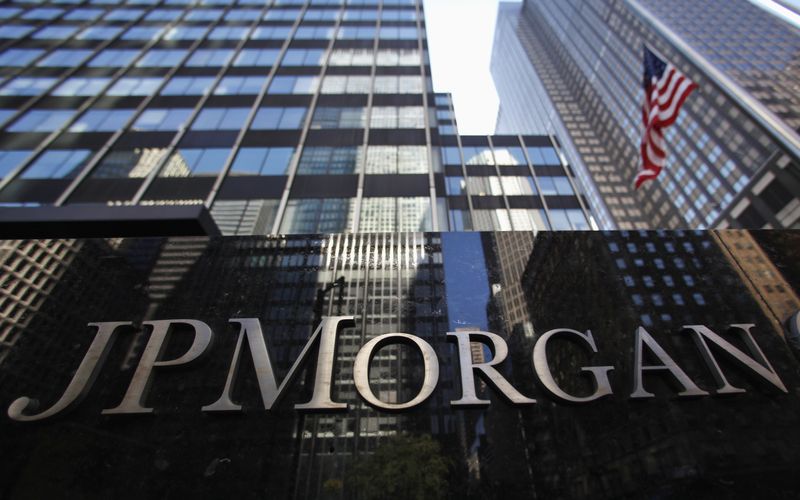
JPMorgan Chase could earn more from interest payments this year as consumers and businesses remain resilient despite economic uncertainty, it said on Monday.
Net interest income — the difference between what the bank pays on deposits and earns from interest payments — could rise by $1 billion this year, Chief Financial Officer Jeremy Barnum told investors.
Still, it was too early to change the full-year NII outlook of $94.5 billion, Barnum said. The bank has repeatedly warned that it was over-earning on NII.
“The evolving tariff environment, combined with the preexisting geopolitical tensions, adds significant uncertainty into the economic outlook,” Barnum told shareholders and analysts gathered at the bank’s New York headquarters for an annual presentation.
“The combination of inflation and large fiscal deficits may constrain the available policy responses in ways that further increase the risk.”
The bank estimated its net charge-off rate, or the percentage of credit card debt that will not be repaid, to be between 3.6% and 3.9% for 2026.
That is higher than the 3.6% net charge-off rate the bank is expecting for 2025.
“We see both consumers and small businesses remaining financially healthy and resilient,” said Marianne Lake, CEO of consumer and community banking. “However, what has definitely worsened is consumer confidence and small business sentiment.”
Although trade negotiations have helped ease some jitters, corporate executives remain wary about the economic outlook, with JPMorgan CEO Jamie Dimon warning last week that a recession could not be ruled out.
Shares were down 1% in premarket trading. The bank maintained its expense forecast for 2025.
M&A, AI OPPORTUNITIES
Barnum said that the biggest U.S. bank is open to acquisitions, or “inorganic growth,” at a time when it is flush with cash, but will be “appropriately cautious” with any acquisitions because of the challenges of integrating businesses.
Since purchasing assets of failed lender First Republic Bank (OTC:FRCB) in 2023, JPMorgan has been relatively quiet on acquisitions.
The bank’s capital was “impressive,” Piper Sandler analyst Scott Siefers wrote in a note. It has “significant flexibility for both defensive and offensive actions,” he said.
Separately, the lender also emphasized the role of artificial intelligence in boosting efficiency.
“The operations team is at the tip of the spear on using and leveraging new AI tools and capabilities,” Lake said. “And based upon what we know today, we expect headcount will trend down by about 10% over the next five years or so.”
Large financial institutions are finding ways to use AI to cut costs and increase productivity, which could dramatically reshape their workforces.
Dimon is set to address shareholders’ questions later on Monday. While investors are not expecting a surprise succession announcement, they will watch out for any signs of who the next CEO could be.
Dimon, 69, has run JPMorgan for more than 19 years, outlasting many other CEOs. He said at last year’s investor day that the succession timeline was “not five years anymore.”
Troy Rohrbaugh and Doug Petno, the co-CEOs of JPMorgan’s commercial and investment bank, are candidates for the top job. Marianne Lake, CEO of consumer and community banking, and Mary Erdoes, CEO of asset and wealth management, are also in the running.
Dimon could also be asked to share his views on the widening fiscal deficits in the U.S., especially after Moody’s downgraded the country’s sovereign credit rating on Friday due to concerns about its $36 trillion debt pile.
He has consistently expressed worries that the deficits were not sustainable and could pose serious risks to the health of the U.S. economy.



 MY INVESTMENT NEWS
Leave a comment