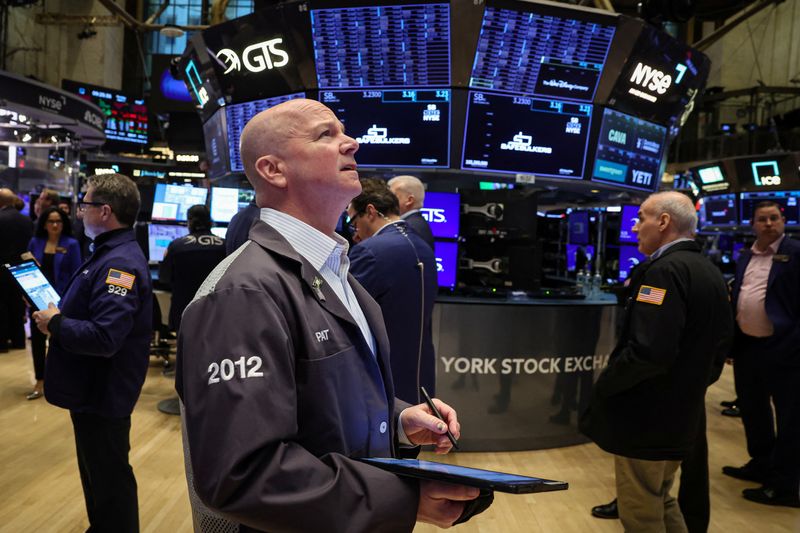
U.S. stock index futures traded in a mixed fashion Tuesday after investors assessed U.S. President Donald Trump’s latest salvo in his aggressive tariff agenda.
At 05:30 ET (09:30 GMT), Dow Jones Futures fell 40 points, or 0.1%, while S&P 500 Futures gained 6 points, or 0.1%, and Nasdaq 100 Futures rose 55 points, or 0.2%.
The main averages on Wall Street ended lower on Monday, falling back from record levels as investors booked profits amid a great deal of uncertainty over the Trump administration’s trade policies.
New deadline and tariff threats
Trump on Monday released letters outlining trade tariffs against a slew of Asian and African countries. He imposed a 25% levy on South Korea, Japan, Malaysia, and Kazakhstan, a 30% levy on South Africa, a 32% levy on Indonesia, a 35% levy on Bangladesh, and a 36% levy on Thailand.
He also signed an executive order postponing the effective date of his tariffs to August 1 from a prior deadline of July 9.
The president later told reporters that his August 1 deadline was not a “100% firm,” and that he remained open to more trade talks and potential deals. U.S. futures curbed losses and were seen turning mildly positive after Trump’s comments.
Trump earlier on Monday released letters outlining trade tariffs against a slew of Asian and African countries. He imposed a 25% levy on South Korea, Japan, Malaysia, and Kazakhstan, a 30% levy on South Africa, a 32% levy on Indonesia, a 35% levy on Bangladesh, and a 36% levy on Thailand.
Notably, the higher tariffs will not combine with previously announced sector tariffs such as those on automobiles, steel, and aluminum. Crucially, letters were not sent to India and the European Union, which analysts and media reports interpreted as an indication that possible trade deals may be imminent.
Treasury Secretary Scott Bessent said he expected to announce more trade deals in the coming days.
Amazon to kick off Prime Day
In corporate news, Amazon (NASDAQ:AMZN) is due to kick off its Prime Day Tuesday, with estimates predicting a spike in digital shopping during the longer-than-usual four-day sales event.
Online spending is anticipated to soar to $23.8 billion across U.S. retailers during Prime Day, according to a forecast from Adobe (NASDAQ:ADBE) Analytics on Monday. Sales are seen jumping by 28.4% compared to last year’s event, which was two days long.
Executives have said the extension was due to Prime members saying they needed more time to shop for deals.
During Amazon’s previous Prime Day in July 2024, American consumers spent $14.2 billion, or a rise of 11% year-over-year, according to figures from Adobe Analytics cited by Reuters.
The economic data slate is largely empty Tuesday, and the focus this week is on the minutes of Federal Reserve’s June meeting, which are due on Wednesday.
The Fed has maintained its stance on keeping rates steady until the inflationary effects of Trump’s tariffs become more clear.
Crude prices slip lower
Crude prices slipped as traders eyed uncertainty over the potential impact of Trump’s tariff hikes, along with lingering concerns from rising OPEC+ output.
At 05:30 ET, Brent futures had inched down 0.4% to $69.27 a barrel and U.S. West Texas Intermediate crude futures fell 0.6% to $67.50 a barrel.
Trump’s tariffs have prompted uncertainty across the market and concerns they could have a negative effect on the global economy and, consequently, on oil demand.
Elsewhere, the Organization of the Petroleum Exporting Countries and its allies, a group known as OPEC+, announced on Saturday that it will increase oil production by 548,000 barrels per day (bpd) in August. The hike was larger than the 411,000 bpd increases already implemented for May, June, and July.


 MY INVESTMENT NEWS
Leave a comment