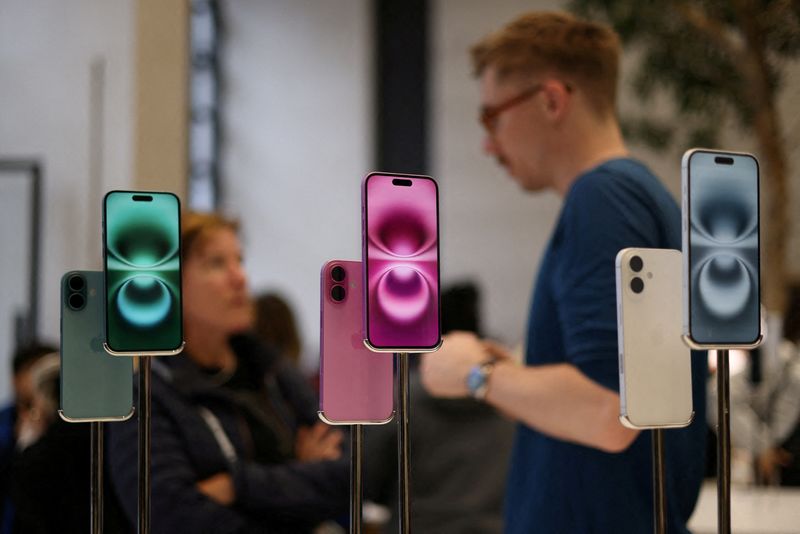
Apple on Tuesday introduced an upgraded line of new iPhones, including a new, slimmer iPhone Air, and held prices steady amid U.S. President Donald Trump’s tariffs that have hurt the company’s profit. The tech giant also launched new Apple Watches and AirPods.
The iPhone Air is thinner and lighter than Apple’s other devices, built on a titanium body, and starts at $999.
Most products announced will be available starting Sept. 19, 2025.
In a Tuesday note to clients, Needham analyst Laura Martin highlighted their top ten takeaways from the launch.
1) ’Economic impact:’ Martin said the event did little to change Needham’s iPhone sales forecasts.
“We saw nothing today that made us want to raise our estimates for iPhone sales,” she wrote, adding that Apple remains “a single product company, with the iPhone as its anchor product.”
“Therefore, AAPL shares will NOT work until there is an iPhone replacement cycle,” Martin added, reiterating the Hold rating on Apple shares.
2) ’Mismatch:’ Apple’s keynote stressed durability, battery life, heat dissipation, camera innovations, and privacy.
But “the #1 thing Wall Street wanted to hear was – Did you give consumers a compelling reason to buy a new iPhone? Since the answer was ‘no,’ shares fell 1.5% immediately after the keynote ended,” Martin said, warning that Apple’s annual cadence carries risks as GenAI disruption shortens innovation cycles.
3) ’Audience breadth:’ Apple’s presentations attempt to appeal to a wide range of constituencies—from consumers to professional filmmakers, engineers, chip enthusiasts, and hardware designers.
Martin argued this breadth often forces the content to do “heavy lifting.”
4) ’Coolest:’ One standout moment came when Apple revealed that the entire keynote had been filmed on an iPhone, which Martin called “walking the walk.”
The analyst also highlighted the launch of the new ultra-thin iPhone Air at $1,000 as the “second-coolest” announcement.
5) ’Strangest choice:’ Apple opened with AirPods, a product line that Needham estimates will bring in about $20 billion in fiscal 2025, less than 5% of revenue.
While the auto-translation feature was described as “super-cool” and a creative use of GenAI, Martin said the product “can NOT move AAPL’s economics materially” given expected total revenue of more than $400 billion.
6) ’Unintended consequences:’ The biggest share price lift during the event—about 40 basis points—came not from new products but from an emotional Apple Watch segment showing lives saved by the device. Once Apple moved back to technical features, the stock gave back gains.
7) ’Apple TV:’ Martin described Apple TV as “an abysmal failure” in streaming, with 25 million paid subscribers and just 0.33% viewing share in July 2025. Still, the analysts noted the Hollywood roster behind it enhances Apple’s product videos, likely helping sell incremental iPhones.
8) ’iPhone 17:’ Martin dismissed the new model as another incremental update.
It brings new colors, more connectivity, upgraded cameras, and longer battery life, but “nothing else that can drive a consumer to buy a new iPhone unless they break their current iPhone,” the analyst said, calling sales predictable and already priced into the stock.
9) ’iPhone pricing:’ The iPhone 17 starts at around $800, the iPhone Air at $1,000, and the Pro at $1,100. Trade-in credit reaches up to $1,100 for an iPhone 13 Pro or newer.
Martin said pricing power is “being limited by its slow pace of innovation,” forcing Apple to add more features simply to retain its base.
10) ’Conclusion:’ Overall, Martin called the launch “a disappointing event.”
“We believe AAPL knew this, as evidenced by the fact that they started it focused on a $20B product,” she added.




 MY INVESTMENT NEWS
Leave a comment