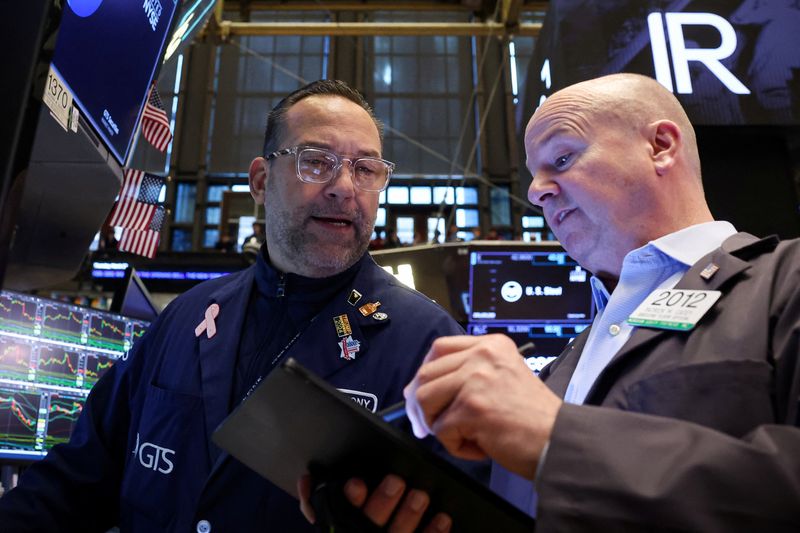
U.S. stock futures edge lower after a mixed session to begin trading in November. Palantir shares slip after-hours even after its third-quarter financial results beat expectations, weighing on other large tech names. Artificial intelligence chipmaker Advanced Micro Devices is due to report its latest quarterly results, while BP’s adjusted net income exceeds estimates and a major institutional investor in Tesla says it will vote against a massive proposed compensation package for CEO Elon Musk.
1. Futures edge lower
U.S. stock futures ticked lower on Tuesday, as investors eyed opinions on the state of the American economy from some Federal Reserve members and kept tabs on a raft of incoming corporate earnings.
By 02:58 ET (07:58 GMT), the Dow futures contract had inched down by 313 points, or 0.7%, S&P 500 futures had fallen by 61 points, or 0.9%, and Nasdaq 100 futures had slipped by 311 points, or 1.2%.
The main indices on Wall Street ended in mixed fashion on Monday, with the blue-chip Dow Jones Industrial Average declining while the benchmark S&P 500 and tech-heavy Nasdaq Composite both gaining.
Markets were assessing corporate dealmaking during the opening session of November. Consumer goods group Kimberly-Clark announced plans to purchase Band-Aid maker Kenvue in a $40 billion transaction, although analysts flagged worries over legal risks surrounding the latter. OpenAI also inked a $38 billion agreement to buy cloud computing services from e-commerce giant Amazon, in the ChatGPT-maker’s first effort to expand its artificial intelligence capabilities since restructuring the business last week.
Meanwhile, divisions among Fed policymakers became more apparent. Speaking publicly for the first time since President Donald Trump attempted to oust her as a Fed Governor, Lisa Cook said much debate has swirled around the pressures facing the central bank’s dual employment and inflation mandates. Cook added that the Fed’s December gathering was a “live” one, suggesting that the decision on interest rates made at the meeting is largely uncertain.
San Francisco Fed President Mary Daly also said that last week’s rate cut was a form of “insurance” to provide a bulwark against further labor market softening, but noted that she will keep an “open mind” heading into next month’s meeting.
2. Palantir shares drop
Shares of Palantir fell in extended hours trading, despite the data analytics titan posting another quarter of record revenue.
Palantir, whose operations also involve software for the defense sector, reported net profit of $475.6 million on $1.18 billion in third-quarter sales, both topping estimates.
Writing in a letter with the release, Chief Executive Alex Karp said the business is “now producing more profit in a single quarter than it did in revenue not long ago.”
The company also forecast better-than-anticipated current-quarter sales, fueled by a boom in AI adoption which has lifted demand for its data analysis services.
Palantir’s stock price has soared by more than 175% so far this year, becoming a reflection of sky-high valuations being driven by the AI craze. Underscoring its influence on sentiment around frothiness in portions of the stock market, Frankfurt-listed shares of several mega-cap tech players who have outlined plans for heavy AI spending dropped.
3. AMD to report
Elsewhere on the earnings calendar, Advanced Micro Devices is set to report after the closing bell on Tuesday, becoming the latest AI chipmaker to release quarterly results following an intense round of dealmaking in the sector.
According to Reuters, the U.S. Department of Energy has created a $1 billion partnership with the semiconductor group to construct two supercomputers necessary to address large scientific problems like cancer treatments and national security.
Last month, AMD also said it would supply AI chips to OpenAI as part of a multi-year deal that would both generate billions of dollars in annual revenue and grant the AI startup access to about a 10% stake in the firm.
Yet the deal joined a host of similarly-circular arrangements which have exacerbated concerns around the possible emergence of an AI bubble reminiscent of the dotcom boom in the late 1990s. Such deals have become increasingly more common, underpinned by the AI industry’s need to fund and expand computing power to meet ever-rising demand for cutting-edge AI models.
Executives at AMD, a major rival to AI-darling Nvidia, said the OpenAI agreement was “certainly transformative” for both the business and the wider AI industry.
Shares of AMD have spiked by more than 115% so far this year.
4. BP adjusted net income tops estimates
BP’s third-quarter underlying replacement cost profit — a measure of adjusted net income — slid by less-than-expected to $2.21 billion, surpassing analyst expectations of $2.02 billion.
The oil major, which was boosted by increased refining margins which helped mitigate the impact of lower crude prices, maintained its quarterly share buyback at $750 million and said it expects asset disposals to total about $5 billion this year.
“We’ve delivered another quarter of good performance across the business with operations continuing to run well,” BP CEO Murray Auchincloss said.
“We are looking to accelerate delivery of our plans, including undertaking a thorough review of our portfolio to drive simplification and targeting further improvements in cost performance and efficiency,” he added.
The company’s net debt stood at $26.05 billion at the end of the quarter, little changed from the previous three months but up from $24.27 billion a year ago. The results come around eight months after BP began a major strategic reset aimed at streamlining its operations and improving returns.
5. Norway wealth fund votes against Musk’s $1 trillion Tesla pay deal
Norway’s sovereign wealth fund — and the world’s largest — has said it would reject a $1 trillion pay package Tesla has put forward for CEO Elon Musk, citing worries over the scope and effect of the award.
Norges Bank Investment Management, which manages the $1.9 trillion fund and was the first major investor to disclose its decision on the matter, said that while it “appreciate[s] the significant value created under Mr. Musk’s visionary role” at the helm of the electric carmaker, “we are concerned about the total size of the award, dilution, and lack of mitigation of key person risk.”
The fund currently has a 1.2% stake in Tesla, making it the sixth-biggest institutional investor in the firm, according to FactSet data cited by the Wall Street Journal. Other big institutional investors, such as BlackRock, Vanguard and State Street, have to yet to announce how they intend to vote.
Tesla is set to hold an annual shareholder meeting later this week, at which it is expected to unveil the results of votes on Musk’s compensation package, among a slew of other proposals. Under the package, Musk would receive an extra 12% stake in Tesla should he successfully guide the firm — which he has recently attempted to pivot to a focus on AI and robotics — to an almost eight-fold jump in its valuation to $8.5 trillion in the next decade.

 MY INVESTMENT NEWS
Leave a comment