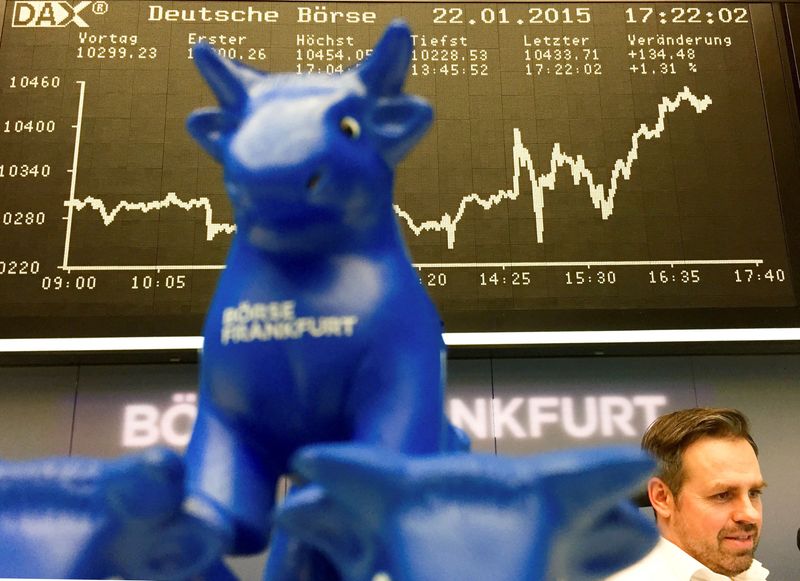
European stocks slipped marginally lower Thursday, with investors digesting more corporate earnings ahead of an eagerly-awaited Bank of England policy decision.
At 03:05 ET (08:05 GMT), the DAX index in Germany slipped 0.2%, the CAC 40 in France dropped 0.3% and the FTSE 100 in the U.K. fell 0.1%.
More earnings to digest
A degree of confidence has returned to global stock markets after the previous session’s weak start to trading, as better-than-expected U.S. economic data calmed fears of overextended valuations.
Helping the tone in Europe, to a certain degree, is the belief that the outlook for European corporate health has substantially improved, as investors’ worst fears for quarterly earnings have failed to materialise.
That said, the region’s main indices are still trading near record highs, offering plenty of opportunity to bank gains as investors digest a deluge of corporate results.
German lender Commerzbank (ETR:CBKG) announced a share buyback of up to €1 billion after posting the strongest nine-month operating profit in its history, underscoring solid business performance across its core divisions.
BT Group (LON:BT) reported a 3% drop in second-quarter revenue, with its Openreach division, which manages the fixed-line network, losing 242,000 broadband customers during the quarter, exceeding the 205,000 decline projected. The company attributed the drop to stiff competition and a weaker broadband market.
Drugmaker AstraZeneca (LON:AZN) reported stronger-than-expected third-quarter results, driven by robust sales across its oncology, cardiovascular and renal portfolios, while keeping its full-year guidance unchanged.
Swedish automaker Volvo Car (ST:VOLCARb) said it was targeting a long-term operating profit margin of over 8% in a strategy overhaul, deepening its cooperation with majority owner Geely to cut costs and enable a strong positive cash flow.
Swedish construction and development company Skanska (ST:SKAb) reported a rise in third-quarter profit despite taking significant property impairments in the United States, as its core construction business delivered stronger-than-expected margins.
Bank of England holds policy meeting
The Bank of England announces its interest rate decision later in the session, with the central bank generally expected to hold its benchmark interest rate at 4.0% as Britain’s inflation rate remains the highest among the Group of Seven major advanced economies.
However, this decision is not seen as a certainty given there have been tentative signs that inflationary pressures are abating, while Chancellor Rachel Reeves is seen increasing taxes at the country’s budget later this month.
Reeves earlier this week talked about having to make “hard choices” to protect public spending while reducing Britain’s debt, likely paving the way for tax rises, breaking an election commitment.
Elsewhere, German industrial production rose less than expected in September, increasing 1.3% over the previous month, below the 3% growth predicted.
The output figure underscores muted economic activity in Europe’s largest economy.
Crude steadied after losses
Oil prices steadied Thursday after recent sharp losses as expectations of a supply glut and softening demand presented a weak outlook for crude.
Brent futures gained 0.3% to $63.68 a barrel and U.S. West Texas Intermediate crude futures rose 0.3% to $59.80 a barrel.
Both contracts slid some 1% each on Wednesday, having fallen for a third straight month in October.
Expectations of more disruptions in U.S. fuel demand, amid a prolonged government shutdown, weighed on crude, as did persistent bets that a supply glut will form in the coming year.
The U.S. Energy Information Administration said U.S. crude stocks rose by 5.2 million barrels to 421.2 million barrels last week, compared with expectations for a 603,000-barrel rise.



 MY INVESTMENT NEWS
Leave a comment