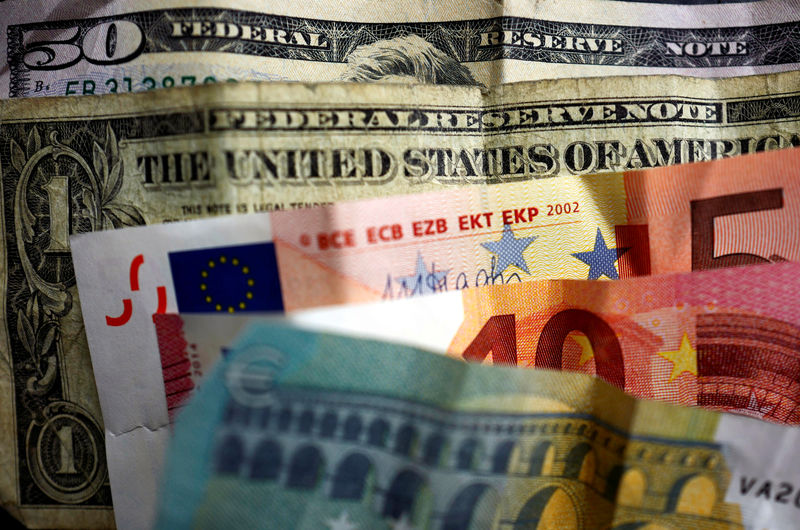
The U.S. dollar plumbed a nearly four-year low on Tuesday as cautious investors were on watch for the Federal Reserve’s latest interest rate decision and any possible currency interventions by the U.S. and Japan.
The Dollar Index, which tracks the greenback against a basket of six other currencies, fell 1.3% to 96.22.
President Donald Trump said he wasn’t concerned about the currency’s decline, noting that it was “seeking its own level” and that it can fluctuate “up or down like a yo yo.”
Dollar hits lowest since February 2022
A fourth straight day of heavy selling led to the Dollar Index hitting its lowest level since February 23, 2022. Traders were cautious as the U.S. central bank’s latest two-day policy meeting kicked off.
The Fed is widely expected to leave rates unchanged, with economic growth showing signs of strength and unemployment still relatively low, and the central bank is likely to stay on hold until it has more clarity on the world’s largest economy.
The dollar has seen a marked fall this month due to factors ranging from concerns over the Fed’s independence to trade and geopolitical decisions by President Donald Trump.
“While I am not in the de-dollarization camp there is definitely a diversification away from the greenback in part due to policy unpredictability coming out of Washington,” Joseph Brusuelas, chief economist at RSM US, noted on X (formerly Twitter).
Currency intervention watch
The yen has also remained in focus in forex markets, having fallen sharply in the prior two sessions after Reuters reported that the New York Fed had conducted rate checks on the currency pair, possibly signaling that U.S. and Japanese authorities may be preparing to intervene.
Speculation over such intervention was also stoked after Japanese Prime Minister Takaichi warned against excessive volatility in the yen.
The yen has also been pressured by a dire selloff in Japanese government bonds sparked by concerns over stretched fiscal spending under Takaichi.
“The yen peaked in the months leading up to the 2012 ’Abenomics’ election. After that, Japan kept policy ultra-easy—through QQE, negative rates and later yield-curve control,” Deutsche Bank’s Jim Reid said.
“After 2021, as U.S. yields surged and energy import costs rose, the yen weakened sharply as the BoJ was seen as ’behind the curve.’ With real yields still deeply negative in Japan, downward pressure persisted until last Friday’s ’rate-check’ episode,” he added.
Euro adds to gains
EUR/USD was flat at 1.2041 on Tuesday, hitting that level for the first time since mid-2021, as investors shunned the dollar.
“Like other FX pairs, EUR/USD has some lively technical chart patterns this week. There is a downside gap to 1.1834 which should now act as support if EUR/USD is preparing to break above range highs at 1.1910/20. At present, we think those highs can hold and that EUR/USD can end the quarter somewhere near 1.17,” said ING.
GBP/USD edged 0.1% lower to 1.3828.
“Sterling’s outperformance this week may well be down to the fact that asset managers were very short GBP/USD positions, which have been left exposed by this week’s dollar sell-off,” said ING.
Elsewhere, USD/KRW slipped 1% to 1,431.95, with the South Korean showing some weakness as U.S. President Donald Trump said he will hike tariffs on certain imports from the country to 25%, citing a delay in Seoul’s enactment of a trade deal with Washington.
AUD/USD and NZD/USD were both little changed at 0.7007 and 0.6040, respectively.



 MY INVESTMENT NEWS
Leave a comment