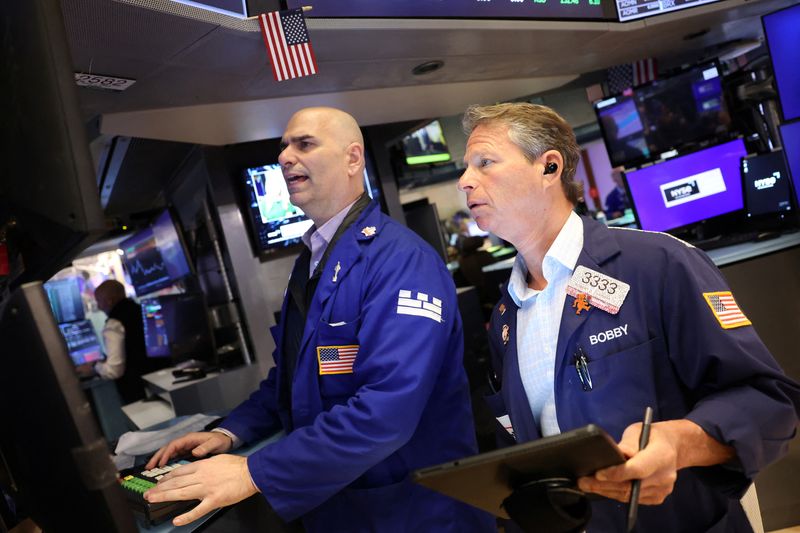
Futures linked to the main U.S. stock averages inch down, with a Supreme Court ruling against President Donald Trump’s emergency tariffs still reverberating through financial markets. Trump responds to the decision by vowing to impose global 15% tariffs, but the duration of these levies is limited. Major U.S. trading partners were also seeking more clarity around what the decision will mean for previously-forged trade deals with Washington.
1. Futures lower
U.S. stock futures pointed lower on Monday, as investors digested a move by President Trump to impose temporary across-the-board tariffs of 15% following a ruling against his emergency levies by the U.S. Supreme Court last week.
By 03:08 ET (08:08 GMT), the Dow futures contract had fallen by 224 points, or 0.5%, S&P 500 futures had slipped by 40 points, or 0.6%, and Nasdaq 100 futures had declined by 185 points, or 0.7%.
The main averages on Wall Street advanced to end the prior week, with the Supreme Court’s much-anticipated decision driving sentiment. While the high court struck down Trump’s use of a 1977 emergency powers law to enact sweeping duties on a host of countries, questions swirled around the ramifications of the ruling, particularly the fate of refunds potentially owed to companies impacted by the tariffs.
“Friday’s Supreme Court ruling sent a strong signal about the limits of presidential power,” analysts at ING said in a note.
However, they added that, with Trump unlikely to use the decision to quietly back down on his aggressive tariff agenda, its unclear where his trade actions will go next.
“Uncertainty is back,” they wrote.
2. Trump to set 15% global tariff after Supreme Court setback
Trump, who called the ruling a “disgrace,” immediately responded by employ a section of the 1974 Trade Act to set 15% global tariffs for as long as 150 days to quickly address “international payment problems.”
An official White House communication had initially stated that the tariffs would be placed at 10% as of Tuesday, but Trump later raised that figure over the weekend.
Crucially, Congress, whose constitutionally-mandated trade powers were at the core of the Supreme Court’s argument to rule against Trump’s emergency tariffs, could extend the so-called Section 122 duties after expiration.
But, as the ING analysts flagged, so could Trump. In theory, the president could allow the surcharge to expire, declare a new emergency, and restart the 150-day period all over again, effectively creating a “de facto perpetual tariff instrument,” they said.
Meanwhile, the U.S. Customs and Border Protection agency has said it will halt collecting tariffs struck down by the Supreme Court at 12:01 a.m. EST (05:01 GMT) on Tuesday — but did not expound on why it was still taking in levies at ports of entry days after the ruling, nor say whether importers would receive possible refunds.
3. U.S. trading partners react to Supreme Court ruling
At the same time, major U.S. trading partners were attempting to suss out what exactly the Supreme Court’s ruling would mean for trade deals notched with the Trump administration in recent months.
The European Commission, the executive arm of the European Union and the chief negotiator for the bloc’s 27 member states, asked that the U.S. stand by the terms of an accord reached in 2025. The Commission also demanded that Washington provide “full clarity” on how its tariff policies will change following the decision.
In a statement, the Commission said the current situation is “not conducive to delivering ’fair, balanced, and mutually beneficial’” transatlantic trade and investment. “A deal is a deal,” it said.
Elsewhere, China — who also held intense negotiations with the U.S. in the wake of a tit-for-tat tariff battle last year — said it was making a “full assessment” of the Supreme Court’s ruling and called on the U.S. to step away from “unilateral tariff measures” on its trading partners.
“Cooperation between China and the United States is beneficial to both sides, but fighting is harmful,” China’s Commerce Ministry said.
4. Waller to speak
Against this backdrop, investors will be keeping tabs on remarks from Federal Reserve Governor Christopher Waller on Monday.
Waller, whose speech in Washington is due to cover the economic outlook, was one of two policymakers who dissented to the Fed’s choice to leave interest rates unchanged at a range of 3.5% to 3.75% in January.
While the Fed cited a stabilizing labor market and steady inflation as reasons to stand pat last month, Waller and fellow Fed Governor Stephen Miran called for a reduction to borrowing costs, pointing to worries that the jobs picture may be at risk of weakening.
The Fed, which slashed rates multiple times in 2025, is still seen resuming cuts later this year, although the exact timing of the drawdowns remains murky. Minutes from the central bank’s January gathering even appeared to suggest that rate hikes could be on the cards, should inflation stay stubbornly above the Fed’s 2% target level.
Potential comments from Waller on prices and jobs, as well as the ramifications of the Supreme Court’s tariff ruling, could be in focus.
5. Oil slips
Oil prices fell sharply, handing back some of last week’s rally as investors weighed the prospect of a third round of U.S.-Iran nuclear talks and fresh uncertainty from U.S. trade policy.
Brent futures dropped 1.3% to $70.39 a barrel, and U.S. West Texas Intermediate crude futures fell 1.4% to $65.55 a barrel.
Both contracts surged nearly 6% last week on concerns of a potential U.S.-Iran conflict as well as an unexpected drop in U.S. crude stockpiles.
The two countries are now expected to hold a third round of nuclear talks on Thursday in Geneva, raising hopes of a diplomatic solution that would dilute the risk of a disruption of crude flows from the Middle East.
Iran is a key producer within the Organization of the Petroleum Exporting Countries (OPEC) and holds some of the world’s largest proven crude reserves.


 MY INVESTMENT NEWS
Leave a comment