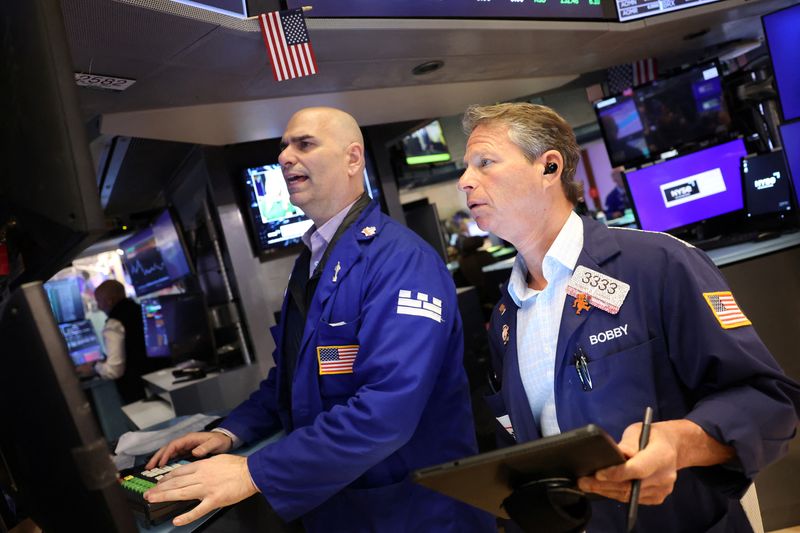
Futures linked to the major U.S. stock indices tick down, with major tech-sector results in focus. Nvidia, which accounts for a sizeable chunk of the U.S. equity market, posts better-than-expected earnings, but investors call for more clarity around when the chip giant’s heavy cash generation will lead to more returns for shareholders. Salesforce shares slump, weighed down by a weak revenue forecast from the software company. Elsewhere, oil steadies ahead of crunch nuclear talks between U.S. and Iranian officials.
1. Futures tick down
U.S. stock futures pointed lower on Thursday, as traders assessed earnings from artificial intelligence-darling and equity-market powerhouse Nvidia.
By 03:05 ET (08:05 GMT), the Dow futures contract had fallen by 122 points, or 0.3%, S&P 500 futures had slipped by 7 points, or 0.1%, and Nasdaq 100 futures had dropped by 27 points, or 0.1%. All of the main averages on Wall Street rose in the prior session, with investors gearing up for Nvidia’s results.
Sentiment on Wednesday was also more upbeat over the outlook for AI, in the latest twist of what has been a roller-coaster narrative around the nascent technology. The Nasdaq was the biggest gainer, reflecting renewed optimism that AI will eventually spark widespread benefits — a marked difference compared to fears earlier this month that software companies will be disrupted by new AI models and mega-cap tech players will struggle to see returns from massive spending on building out data centers.
Comments about AI from Richmond Fed President Tom Barkin also aided stocks. Barkin suggested that it is not yet clear if automation will cause widespread unemployment, adding that AI could even help make the job market more efficient.
2. Nvidia shares flat despite solid earnings
Nvidia posted higher-than-anticipated earnings for the January quarter and projected current-quarter revenue that topped expectations, yet the stock was muted in after-hours trading.
Investors flagged worries that the semiconductor titan was not returning enough to shareholders. Yvette Schmitter, CEO of IT consulting firm Fusion Collective noted that Nvidia generated $35 billion in cash during the fourth quarter, but gave back only 12%, down from 52% this time last year.
Schmitter added that “this is happening at the same time Nvidia is claiming” that its sold-out Ampere chips are a “good signal for demand.”
“[W]hy is the company with record cash generation cutting buybacks by half?” Schmitter said.
The comments echoed a question posed to Nvidia executives in a post-earnings call, when an analyst at UBS asked if the company planned to return some of the $100 billion in cash it was anticipated to rake in this year. CFO Colette Kress stressed that Nvidia is aiming to continue investing in the broader AI ecosystem, while CEO Jensen Huang argued that the output of AI models would be the backbone for future computing.
3. Salesforce slips on weak revenue outlook
Shares of Salesforce tumbled in extended hours trading, meanwhile.
The cloud-based software company unveiled a fiscal 2027 revenue forecast which was short of Wall Street estimates, a sign that demand for business-facing software may be taking a hit as more companies rein in budgets during a time of broad economic uncertainty.
Full-year revenue is seen coming in at a range of $45.80 billion to $46.20 billion, slightly missing at the midpoint expectations of $46.06 billion, according to LSEG data cited by Reuters.
Meanwhile, Salesforce is making big investments into its AI capabilities, in a bid to soothe investor jitters that new models like those from startup Anthropic could eat into demand. These concerns have made the start of 2026 volatile for Salesforce, as the California-based group attempts to ward off what some perceive to be AI’s existential threat to the wider software-as-a-service industry.
Still, Salesforce lifted its forecast for fiscal 2030 revenue to $63 billion from $60 billion previously, highlighting an anticipated boost to growth from so-called agentic AI.
“[T]his is not a perfect report, but it should cross the ’good enough’ threshold, with the company’s AI products showing rapid growth (albeit off a very small base) while core business holds in well (in terms of margins and growth) and cash flow generation stays healthy,” analysts at Vital Knowledge said in a note.
4. Oil steady ahead of U.S.-Iran talks
Oil prices were largely steady Thursday, hovering near seven-month highs, as markets braced for the third round of U.S.-Iran nuclear talks later in the session.
Brent futures climbed 0.2% to $70.84 a barrel, and U.S. West Texas Intermediate crude futures rose 0.2% to $65.62 a barrel.
U.S. envoys, including special representative Steve Witkoff and presidential adviser Jared Kushner, are due to meet Iranian counterparts in Geneva later in the session, as Washington pushes for an agreement over Tehran’s nuclear program.
U.S. President Donald Trump has said that “bad things” could happen if meaningful progress is not achieved, and an extended conflict could disrupt supplies from Iran, the third-biggest crude producer in the Organization of the Petroleum Exporting Countries.
5. Gold inches up
Gold prices edged higher as U.S. trade tariff jitters supported safe-haven demand, while investors awaited the start of the key nuclear talks between Washington and Tehran.
Spot gold was last up 0.6% at $5,196.55 an ounce by 01:40 ET (06:40 GMT). U.S. Gold Futures slipped 0.5% to $5,200.54/oz.
Along with the diplomatic developments between the U.S. and Iran, traders are gauging the impact of newly-announced U.S. tariffs following a recent ruling by the U.S. Supreme Court that quashed President Trump’s sweeping “reciprocal” tariffs.
Global markets are awaiting U.S. economic data later in the day as well, including weekly jobless claims figures. So far this year, bullion has remained well supported by persistent geopolitical tensions, central bank purchases and portfolio diversification flows.



 MY INVESTMENT NEWS
Leave a comment