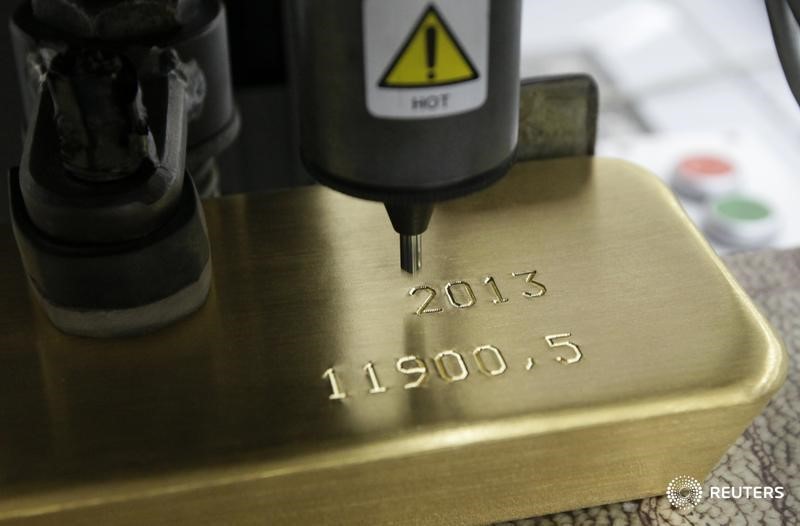
Gold prices rose on Tuesday but remained within a tight trading range as markets waited to see how a U.S. naval blockade of Iran would play out, while upcoming inflation data from the world’s largest economy also spurred caution.
Bullion prices remained squarely in a trading range seen over the past week as concerns over the inflationary impact of the Iran war largely overshadowed safe haven demand for the gold and precious metals.
Spot gold rose 0.5% to $4,762.42 an ounce by 01:42 ET (05:42 GMT), while gold futures rose 0.4% to $4,784.05/oz. Spot prices flitted largely between $4,900/oz and $4,700/oz over the past week.
Other precious metals also mostly firmed, with spot silver up 1.4% to $76.6375/oz, while spot platinum rose 0.6% to $2,087.69/oz.
Gold takes some relief from softer dollar; Iran blockade begins
Gold and broader metal prices were encouraged by weakness in the dollar, as markets looked to some de-escalation in the Iran war after the U.S. began a naval blockade against Tehran.
A host of reports also showed the U.S. and Iran remained open to a fresh round of talks after weekend negotiations in Pakistan yielded few results. Bloomberg reported that U.S. and Iran officials are discussing a second round of talks before a two-week ceasefire expires next week.
U.S. Vice President JD Vance– who led the Pakistan talks– also expressed some optimism over progress towards a deal, and noted that it was up to Iran to decide whether a deal could be reached.
The dollar retreated as risk appetite improved on the prospect of a ceasefire deal, although said agreement still appeared distant. Risk-driven assets- specifically equities– logged strong gains on Monday and Tuesday.
US PPI data awaited for more cues
U.S. producer price index inflation data is due later on Tuesday, and is expected to offer more cues on the world’s largest economy.
The print will be closely watched for more signs of an energy-driven inflationary bump in March, especially after consumer price index inflation data released last week showed a sharp increase in price pressures.
The onset of the Iran war greatly disrupted global energy markets, sending oil and gas prices up substantially as Tehran blocked a key waterway– the Strait of Hormuz.
The oil price spike in turn drove concerns that energy-fueled inflation will push the Federal Reserve and other major central banks into a more hawkish cycle in the coming months.
This notion was a major point of pressure on gold prices, dragging them further off record highs hit it late-January.

 MY INVESTMENT NEWS
Leave a comment