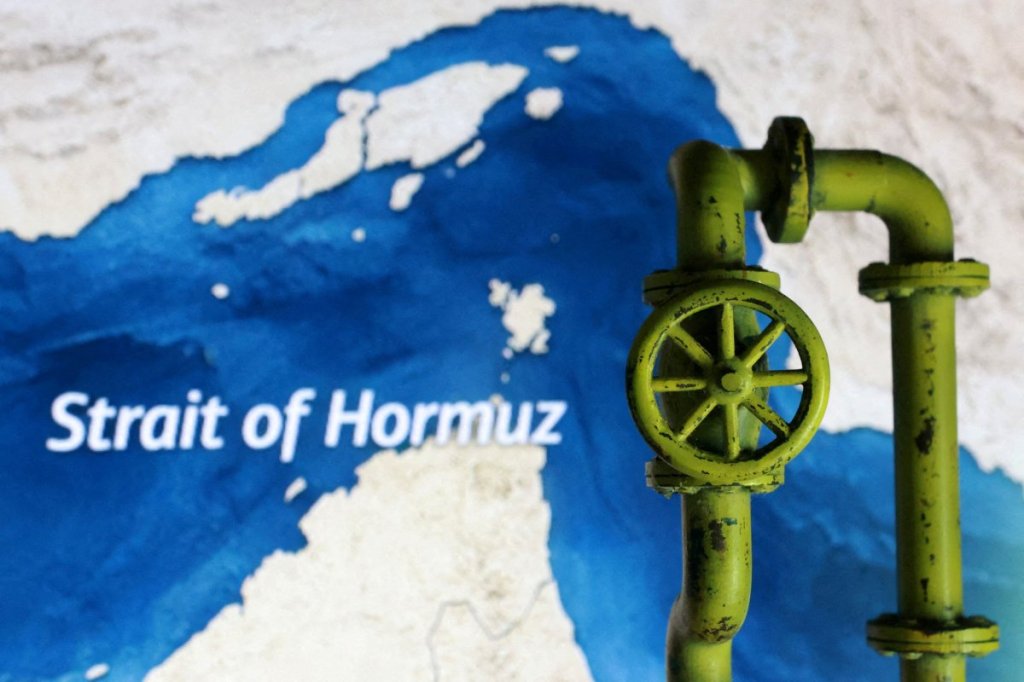
A U.S. military blockade of Iranian ports stretched into a second day on Tuesday, even as hopes surrounded potential forward momentum in peace talks between Washington and Tehran.
British maritime officials noted that access has been restricted for vessels attempting to enter or depart Iranian ports, as well as in coastal areas in the Persian Gulf, Gulf of Oman and sections of Arabian Sea.
U.S. President Donald Trump said the blockade took effect on Monday, after weekend talks to establish a permanent ceasefire with Iran did not yield an immediate result. The move has threatened to further constrain already shuttered oil flows through the Strait of Hormuz, a vital waterway through which a fifth of the world’s oil supply traverses.
The effective closure strait has become a central flashpoint since the start of the conflict in late February, driving up oil prices and darkening the wider global economic outlook.
Citing supply chain experts, the Associated Press reported that the U.S. blockade could undermine the flow of oil, fertilizer, food and other goods to consumers already grappling with rising prices.
The AP reported that the U.S. has deployed 16 warships to the Middle East, although none of them are in the Persian Gulf, which forms much of Iran’s coastline.
For its part, Iran has hit out at the U.S. blockade as an “act of piracy” and warned that no Persian Gulf port would be safe if its own were threatened.
Saudi Arabia has been attempting to persuade the U.S. to drop the blockade, fearing that the action could cause Iran to disrupt other crucial global shipping routes, the Wall Street Journal reported.
Diplomacy efforts
Yet diplomatic efforts have appeared to gain some traction. The U.S. and Iran have continued to engaged with one another and there has been some forward motion toward a permanent ceasefire deal, Reuters reported.
Trump has also noted that the White House had been contacted by Iranian officials who would like to “make a deal,” adding that Iran will not have a nuclear weapon. Washington has reportedly demanded that Iran agree not to enrich uranium, a key part of the process of building a nuclear weapon, for 20 years.
Meanwhile, Pakistan, which has emerged as a key mediator between the U.S. and Iran, has offered to host a second round of discussions prior to the end of the ongoing two-week ceasefire, according to reports. The first talks were held in Islamabad last weekend.
Elsewhere, Israel and Lebanon are due to begin direct peace talks in Washington on Tuesday. Air attacks by Israel on targets in Iran-aligned Hezbollah targets in Lebanon have been a key sticking point threatening the fragile halt to hostilities between the U.S. and Iran.
U.S. Secretary of State Marco Rubio will take part in the discussions between Israel and Lebanon, the WSJ said, quoting a State Department official.
Oil prices dipped back below $100 a barrel amid optimism around a deal to end the fighting in the Middle East. Brent crude futures, the global benchmark, were last down by 0.9% to $98.47 a barrel, while U.S. West Texas Intermediate crude futures declined by 2.0% to $97.07 a barrel.
The U.S. dollar, which has been viewed as a bastion for investors during the conflict, weakened slightly as well.
“Markets remain keen to jump into the de-escalation trade, and some tentative signs that the U.S. Hormuz blockade is leading to a new round of talks were enough to add plenty of pressure on USD,” analysts at ING said in a note.

 MY INVESTMENT NEWS
Leave a comment