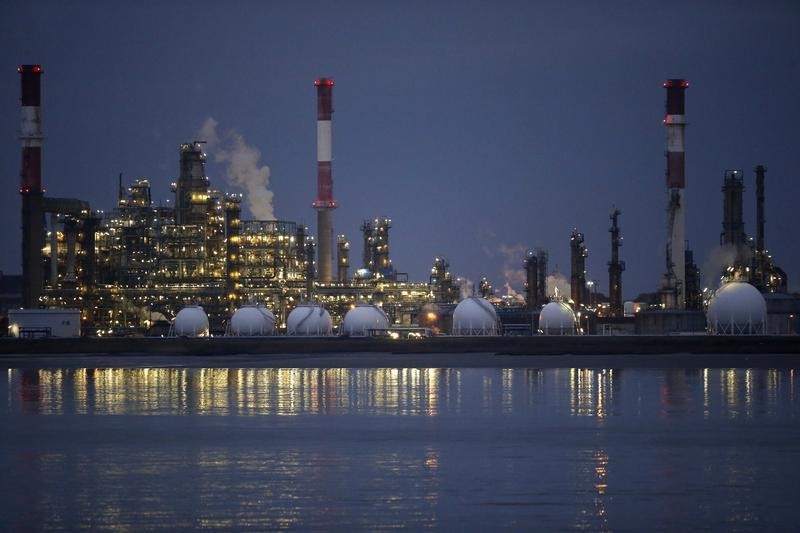
Oil prices fell on Friday after U.S. President Donald Trump suggested that negotiations between Washington and Tehran may resume this weekend, as a fragile ceasefire between Israel and Lebanon appeared to be holding.
Brent oil futures declined 2.0% to $97.36 a barrel, while U.S. West Texas Intermediate crude futures dropped 2.6% to $92.19 a barrel by 05:24 ET (09:24 GMT).
At these levels, Brent, the global oil benchmark is on track for a gain of over 1% in the past one-week period and WTI for a drop of more than 5%.
Washington and Tehran are “very close” to reaching a deal, Trump said, adding that Iran has agreed not to possess a nuclear weapon for more than 20 years. A desire to quell Iran’s nuclear ambitions has been cited Trump as a central reason for the war, which began with joint U.S. and Israeli strikes on Iran in late February.
In return, Iran has called for the removal of international sanctions.
Trump flagged that he would consider extending the ceasefire if Washington was close to an agreement with Tehran.
Crucially, a new 10-day halt to hostilities between Israel and Lebanon could remove another key sticking point in negotiations. Despite the U.S.-Iran ceasefire, Israel has continued to carry out strikes on Iran-aligned Hezbollah militants in neighboring Lebanon. Iran has demanded that such attacks stop before an agreement with the U.S. can be secured.
“I hope Hezbollah acts nicely and well during this important period of time,” Trump said in a social media post.
Oil below $100
Oil prices sat below $100 a barrel, with traders keeping tabs on hopes for a long-term peace deal.
Following the outbreak of the war, crude briefly surged to as high as $120 a barrel, compared to pre-conflict levels of around $70 a barrel.
Underpinning much of the surge has been the effective closure of the Strait of Hormuz, a narrow waterway off of Iran’s southern coast through which roughly a fifth of the world’s oil squeezes. Analysts at ING have estimated that around 13 million barrels per day of oil have been disrupted by the shuttering of the strait.
The uptick has in turn sparked fears around a spike in inflation in countries around the world that could dampen global economic growth. There has been subsequent debate around the cascading impact of these trends on everything from central bank interest rate policy to gold and currencies.
Both the International Energy Agency and the Organization of Petroleum Exporting Countries warned of softer demand in the coming months, while a trickle of shipping through the Strait of Hormuz and an ongoing U.S. blockade of Iranian ports may hit supplies.
“Control of the strait remains the main flashpoint,” OCBC analysts said, warning that U.S.-Iran negotiations could take as much as six months.
France and Britain are set to chair a meeting on Friday of roughly 40 countries which aims to signal to the U.S. that they are willing to play a part in unblocking the strait. Trump has frequently criticized other nations, including U.S. allies, for not immediately helping Washington’s efforts to reopen navigation through the chokepoint.
Meanwhile, a U.S. blockade of Iran that began earlier this week has intensified. U.S. military officials have stressed that the restrictions apply to Iran’s ports and coastline, not the Strait of Hormuz.
“It’s unclear if, and how, the U.S. blockade […] will shift Iran’s negotiating stance, but the regime is clearly now in a worse position than it was when oil exports were flowing,” said Jason Tuvey, Deputy Chief Emerging Markets Economist at Capital Economics, in a note.
 MY INVESTMENT NEWS
Leave a comment