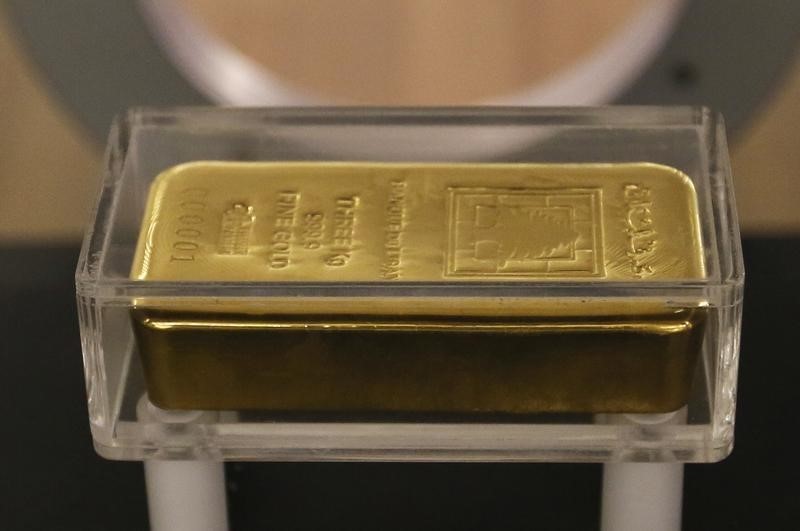
Gold prices ticked higher on Wednesday, underpinned by a weaker dollar, as President Donald Trump’s announcement of an extended ceasefire agreement with Iran supported guarded hopes for a prolonged detente in the Middle East.
By 06:07 ET (10:07 GMT), spot gold had climbed by 0.7% to $4,750.76 an ounce, while gold futures gained 1.1% to $4,769.41 an ounce. The yellow metal was nursing losses from the prior session after Federal Reserve Chair nominee Kevin Warsh said he made no promises to Trump that he will cut interest rates if confirmed.
Bolstering bullion was a fall in the U.S. dollar, which can lift demand for the yellow metal by making it less expensive for overseas buyers. An index tracking the greenback against six currencies was last lower by 0.1%.
The dollar spiked in March, as investors flocked to the currency in the belief that strong U.S. energy exports will help insulate the American economy from an energy shock caused by oil supply disruptions in the Strait of Hormuz. But the currency is now back to around pre-war levels, with some analysts arguing that the peak of the geopolitical turmoil stemming from the Iran war may have passed.
“[T]he majority of the public comments we see, from both sides, at present, largely seem aimed at obtaining negotiating leverage, as opposed to being geared towards seeking actual re-escalation of the conflict,” said Michael Brown, Senior Research Strategist at Pepperstone, in a note.
Trump’s ceasefire extension in focus
In a statement on social media on Tuesday, Trump said that he had agreed to the ceasefire extension at the request of Pakistan, a frequent mediator between the U.S. and Iran.
Iran’s foreign ministry spokesperson acknowledged the ceasefire extension in comments carried by Iranian state television, the Associated Press reported.
Meanwhile, uncertainty swirled around future peace talks between the U.S. and Iran on Wednesday, An anticipated trip to Pakistan for a fresh round of negotiations with Iran by U.S. Vice President JD Vance was put on hold as well, following an announcement from Iranian state media that its delegation deemed the talks to be a “waste of time because the U.S. prevents reaching any suitable agreement.”
But Pakistan’s top political and military leadership has been working to keep the talks from collapsing, the Associated Press reported, citing Pakistani officials.
Pakistan is also waiting to hear from Iran on when it will send a delegation to Islamabad for a second round of discussions with American officials, according to the AP. Previous talks earlier this month ended without a peace deal.
Supply disruptions through the Strait of Hormuz persisted on Wednesday.
Shipping monitor U.K. Maritime Operation said a container ship in the strait was attacked, shortly after a boat belonging to Iran’s Islamic Revolutionary Guards Corps struck a vessel in the area.
Trump has also said an ongoing U.S. blockade of Iranian ports and coastline — an action that Iran’s foreign minister has argued constitutes an “act of war” — will stay in place. He argued that Iran is “collapsing financially!” and wants the strait to be “opened immediately” because Tehran is “Starving for cash.”
Tanker shipping through the Strait of Hormuz, a vital waterway off of Iran’s southern coast through which roughly a fifth of the world’s oil traverses, has been all but closed since the start of the war in late February.
Oil prices rose on Wednesday, with Brent crude futures, the global benchmark, sitting just below $100 a barrel. A spike in crude compared to pre-war levels has sparked fears over an inflationary surge that could weigh on global growth and cause central banks to hike interest rates.
As a non-yielding asset, gold tends to underperform in higher interest rate environments.
 MY INVESTMENT NEWS
Leave a comment