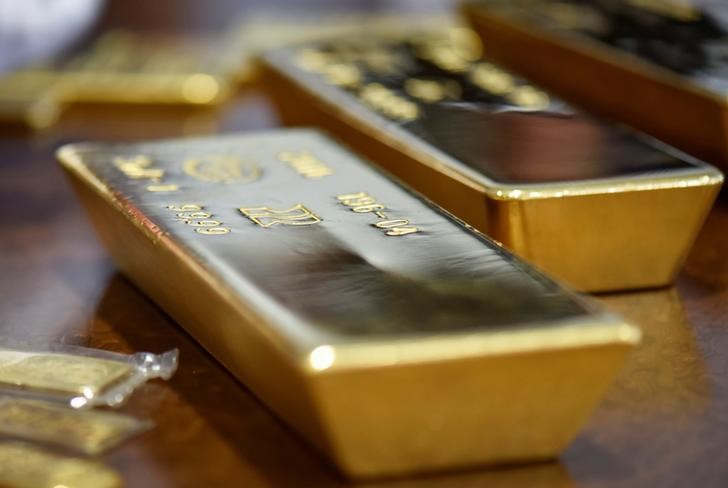
Gold prices edged lower on Wednesday, as traders assessed signs of prolonged Middle East turmoil and geared up for a key Federal Reserve interest rate decision.
By 06:27 ET (10:27 GMT), spot gold had fallen by 0.5% to $4,572.96 an ounce, while gold futures dropped by 0.5% to $4,585.80 an ounce.
Other precious metals were also nursing steep losses in recent sessions. Spot silver slid 0.2% to $73.0465/oz, while spot platinum dipped 0.7% to $1,929.63/oz.
Trump preparing for prolonged Iran blockade – WSJ
U.S. President Donald Trump told aides to prepare for a prolonged naval blockade against Iran, the Wall Street Journal reported on Tuesday evening. The move is aimed at intensifying pressure on Iran’s economy by cutting off its ability to export oil, further pushing Tehran towards a deal.
Reports earlier this week showed Trump largely unhappy with an Iranian proposal to reopen the Strait of Hormuz and end the war, given that the proposal called for the postponement of talks on Iran’s nuclear activities.
A prolonged naval blockade is likely to draw more ire from Iran, which could retaliate by keeping the Strait of Hormuz closed in the near-term. Such a scenario stands to further disrupt oil flows in the Middle East.
Fears of oil-driven price gains, which, in turn, could elicit more hawkish signals from global central banks, have been a major weight on gold prices since late-February. Markets have fretted that higher-for-longer rates will increase the opportunity cost of investing in non-yielding assets such as gold, largely overshadowing bullion’s safe haven appeal.
Instead, investors have looked to the U.S. dollar as a bastion during the crisis, sending a tracker of the greenback against a basket of currency peers above pre-war levels. This may not bode well for gold, as it could make dollar-denominated bullion more expensive for overseas buyers.
“For gold to regain stronger traction, markets may need to see either a pullback in oil prices or signs that geopolitical tensions are easing enough to revive dovish Fed pricing,” OCBC analysts said in a note.
Oil prices shot higher, with Brent crude prices, the global benchmark, once again hovering above $110 a barrel. Prior to the start of the Iran conflict, Brent was floating at closer to $70 a barrel.
Fed meeting looms large
Markets were also focused on the Fed, with the central bank widely expected to leave interest rates unchanged at the conclusion of the Fed’s two-day meeting.
According to the Wall Street Journal, the Fed could tweak the language of its forward guidance in a hawkish direction by removing the potential for rate cuts later in 2026.
Bets have grown that the Fed will keep rates steady for the rest of this year, especially in the face of Iran war-linked energy shock that has placed upward pressure on inflation.
Beyond the Fed, interest rate decisions at the European Central Bank and the Bank of England are also due this week.


 MY INVESTMENT NEWS
Leave a comment