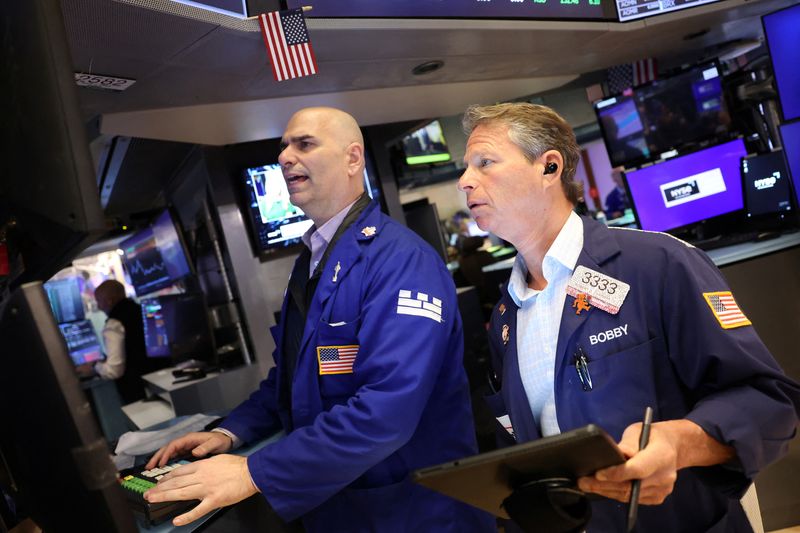
Futures linked to the main U.S. averages are muddled, with traders digesting a range of factors, including a flood of mega-cap tech earnings, a renewed spike in Brent crude prices, and a critical Federal Reserve interest rate decision. The relentless pace is not soon to let up: More earnings lie ahead, as well as additional central bank rate decisions.
1. Futures mixed
U.S. stock futures hovered around the flatline on Thursday, as investors raced to keep up with a flurry of market-moving announcements this week.
By 03:35 ET (07:35 GMT), the Dow futures contract had fallen by 275 points, or 0.6%, S&P 500 futures had slid by 6 points, or 0.1%, and Nasdaq 100 futures had gained 30 points, or 0.1%.
The main averages on Wall Street were mixed in the prior session.
Along with a bevy of broadly solid corporate earnings, traders were also picking through the details of a consequential Federal Reserve interest rate decision.
2. Tech earnings
After markets closed, a slew of quarterly returns from mega-cap tech companies also offered a fresh glimpse in the state of massive artificial intelligence spending plans.
Alphabet led what analysts at Deutsche Bank described as a “decent set” of earnings from members of the so-called Magnificent 7 group of big tech industry players.
Shares of the Google-parent climbed in extended hours trading, thanks in part to higher-than-anticipated cloud revenue growth. E-commerce titan Amazon also rose, buoyed by the biggest expansion of revenue at its key Amazon Web Services unit since 2022.
Cloud revenue at software name Microsoft roughly met expectations, while the firm guided for an acceleration in the second half.
But Meta slipped after-hours after the Instagram-owner lifted its proposed 2026 capital expenditures by $20 billion to between $125 billion to $145 billion.
Altogether, the four giants shelled out a record $130.65 billion in the first three months of the year, mostly on building out the data centers needed to power AI. That was 71% greater than what they spent in the same quarter a year ago.
3. Oil surges
As markets were pouring through the finer points of these returns, a news report sparked a fresh surge in oil prices to their highest level since the start of the Iran war in late February.
President Donald Trump will receive a briefing on carrying out another potential military strike on Iran later today, Axios reported. The action aims to cajole Tehran back to negotiating table, with talks having stalled due to an impasse over Iran’s nuclear ambitions.
On Wednesday, Trump also posted on social media: “Iran can’t get their act together. They don’t know how to sign a nonnuclear deal. They better get smart soon!”
In a note, analysts at ING argued that these developments have dented recent hopes that, despite the deadlock with Iran, the White House was starting to wind down the war.
“The oil market has moved from over-optimism to the reality of the supply disruption we are seeing in the Persian Gulf,” the ING analysts wrote.
4. Powell to remain on Fed board
Elsewhere on Wednesday, the Federal Reserve stood pat on interest rates as expected, albeit in the most contentious decision since the early 1990s — a revealing peek into deep divisions growing between officials.
While leaving rates unchanged at a range of 3.5% to 3.75%, the Fed also opted to make no changes to the language of its policy statement, which currently suggests that the next move for rates will down rather than up. Four of the 12 members of the rate-setting Federal Open Market Committee dissented to the statement.
Fed Chair Jerome Powell also declared that he would stay on at the central bank’s board after his chairmanship ends in May, a major departure from past precedent that could overshadow the handoff to Kevin Warsh, Trump’s pick to succeed Powell.
Powell said he was concerned about “the series of legal attacks on the Fed,” adding that these “threaten our ability to conduct monetary policy without considering political factors.”
The Justice Department suspended a criminal investigation into Powell’s handling of renovations to the Fed’s headquarters last week. Powell said the legal battle had left him with “no choice” but to stay.
5. ECB, BOE decisions ahead
With the specter of renewed bombardments in the Middle East and elevated oil prices looming, the European Central Bank and Bank of England will also unveil interest rate decisions on Thursday.
The ECB is anticipated to keep its deposit rate steady at 2%, but the Deutsche Bank analysts flagged that, due to Europe’s exposure to climbing crude prices, markets are expecting an increase in borrowing costs at its next gathering in June.
“[S]o the question today is whether the ECB validates that view,” the Deutsche Bank analysts wrote.
For the BOE, policymakers are also seen keeping rates steady at 3.75%, but warning of twin risks of slowing growth and rising inflation in the broader outlook.


 MY INVESTMENT NEWS
Leave a comment