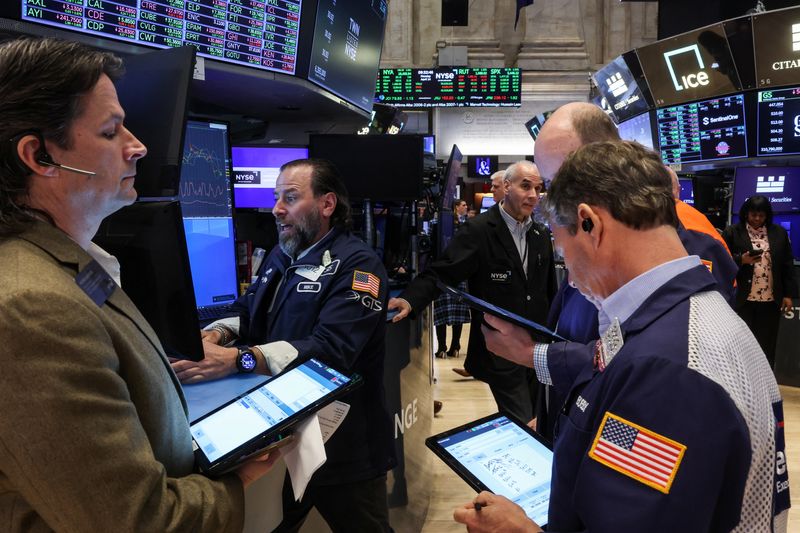
Futures linked to the main U.S. stock indices hover not far from the flatline. Comments from U.S. President Donald Trump reignite speculation around a potential peace deal with Iran, although oil prices remain far above pre-war levels as uncertainty swirls around the negotiations. Elsewhere, Alphabet’s Google and Blackstone announce plans to launch a new artificial intelligence cloud company and Japan’s economy grows at a solid pace in the first quarter, but headwinds from the Iran conflict loom.
1. Futures muted
U.S. stock futures were subdued on Tuesday, as investors assessed renewed hopes for a permanent peace deal in the Middle East and awaited key tech sector earnings later this week.
By 03:30 ET (07:30 GMT), the Dow futures contract was mostly unchanged, S&P 500 futures were down by 6 points, or 0.1%, and Nasdaq 100 futures fell by 46 points, or 0.2%.
On the earnings front, traders will be keeping tabs on returns from DIY chain Home Depot, the first of a raft of figures from consumer-facing retailers in the coming days. However, the highlight of the week will be results from semiconductor giant Nvidia, which stand to offer a glimpse into the state of an artificial intelligence boom that has helped barricade stock markets against the impact of the Iran war.
The main averages on Wall Street finished in mixed fashion on Monday, with the tech-heavy Nasdaq Composite and benchmark S&P 500 both falling. The outperformer was the blue-chip Dow Jones Industrial Average, which advanced by 0.3%.
Along with some profit-taking in tech stocks, market sentiment was clouded by an uptick in U.S. Treasury yields and elevated oil prices.
2. Trump calls off new attacks on Iran
But a social media post from President Trump spurred on the S&P 500 to erase most of its intra-day decline, analysts at Deutsche Bank said in a note.
Trump said he had called off carrying out fresh attacks on Iran, following a request from a clutch of Gulf leaders. The president claimed that “serious negotiations are now taking place,” adding that, “in the opinion” of the Gulf authorities, a “Deal will be made, which will be very acceptable to the United States of America, as well as all Countries in the Middle East, and beyond.”
He added that the agreement will include “NO NUCLEAR WEAPONS FOR IRAN!” — although he flagged that he had ordered the U.S. military to remain prepared to launch a “full, large scale assault on Iran, on a moment’s notice” if an accord is not reached.
“The news helped remove some of the risk premium that had built up over the course of yesterday,” the Deutsche Bank analysts said.
Iranian state media reported that Tehran, for its part, had sent out a new peace proposal to the U.S. which would end hostilities on all fronts, see the exit of U.S. forces from areas close to Iran, and reparation for damage caused by American and Israeli attacks.
3. Oil prices, bond yields in focus
Brent crude futures, the global oil benchmark, were last trading down by 1.8% at $110.07 a barrel. Before the start of the joint U.S. and Israeli assault on Iran in late February, the contract was exchanging hands at about $70 a barrel.
Worries have abounded that an energy shock could lead to a spike in inflation around the world and, in turn, a wave of interest rate hikes by central banks.
Still, the decline in oil prices has allowed global bonds to steady after a steep sell-off in recent days. Yields on the benchmark 10-year U.S. Treasury note cooled from a more than one-year high, while the rate-sensitive 2-year yield was also down marginally.
Yields in the Eurozone, including Germany, France, Spain, and Italy, were all lower as well. Bond prices tend to move in the opposite direction to yields.
“While near-term yield volatility may keep markets on edge, current attractive yields and growth risks point to an appealing risk-return profile for short- and medium-maturity quality bonds,” analysts at UBS Global Wealth Management said in a note.
4. Google, Blackstone plan new AI cloud company
Alphabet’s Google and Blackstone Inc said they will launch a new AI cloud company using Google’s specialized chips.
Blackstone will invest $5 billion in the company and will be the majority owner of the venture, the two companies said in a statement. The project aims to bring 500 megawatts of computing capacity online by 2027, the companies said, and will target substantially increasing capacity over time.
The venture will likely rival AI compute providers such as CoreWeave, and will also intensify Google’s attempts to build and monetize its own AI computing chips, presenting potential competition to Nvidia.
5. Japan’s first-quarter growth beats forecasts
Japan’s economy expanded faster than expected in the first quarter, supported by stronger private consumption and exports, reinforcing expectations that the Bank of Japan could continue gradually normalizing monetary policy despite mounting global risks.
Preliminary government data released on Tuesday showed gross domestic product grew an annualized 2.1% in the January-March quarter, beating market forecasts for 1.7% growth and accelerating from a revised 0.8% expansion in the previous quarter.
Quarter-on-quarter, the economy grew 0.5%, above expectations for a 0.4% increase and faster than the prior quarter’s 0.2% gain.
However, analysts warned that the impact of the Iran war, which has crimped crucial energy supplies to several Asian countries, including Japan, may soon be more keenly felt.
“Japan’s economy approached the Iran war with solid momentum but we think that GDP growth will grind to a halt this quarter and next,” Capital Economics analysts said in a note.
“Looking ahead, the government’s decision to cap prices of petroleum products means that inflation will remain subdued for now. However, that’s unlikely to last as higher energy prices are lifting prices of imported products and will feed through to higher utility bills in due course.”



 MY INVESTMENT NEWS
Leave a comment