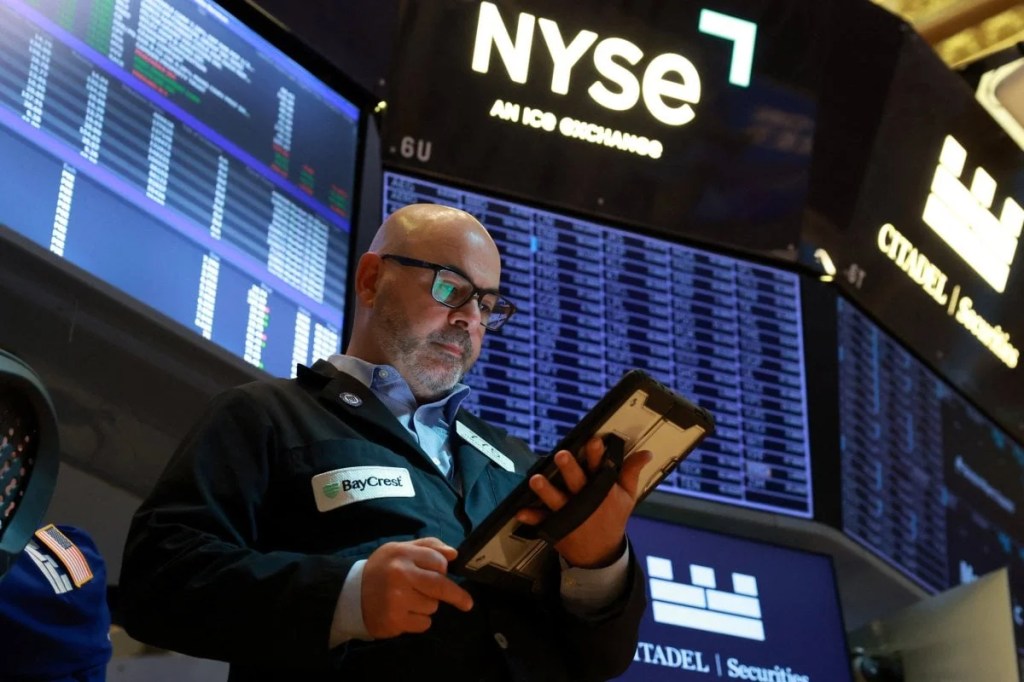
Wall Street was mostly lower on Tuesday, as the technology sector slid on the back of a decline in chip stocks. Investors also assessed renewed Middle East tensions.
At 10:12 ET (14:12 GMT), the benchmark S&P 500 index shed 0.5% to 7,501.97 points, the tech-heavy NASDAQ Composite slipped 1.2% to 25,805.28 points, and the blue-chip Dow Jones Industrial Average reversed course and was last down 0.1% to 53,020.44 points.
The main averages on Wall Street rose on Monday, pushing the Dow up above the 53,000 level for the first time. Driving sentiment was a jump in technology stocks, particularly chipmakers like Advanced Micro Devices and Western Digital. Broadcom also advanced on the news that it was partnering with iPhone-maker Apple to develop new custom chips. The Philadelphia Semiconductor Index, which tracks the chip sector, rebounded after a decline last week.
Although debate has swirled around the longstanding viability of massive spending on AI, demand appears to remain robust for the high-end memory chips and data centers powering the nascent technology.
Samsung Electronics provided further proof of this on Tuesday, when the South Korean firm unveiled preliminary quarterly operating profit which was almost 20 times higher than a year ago. Operating profit came in at 89.4 trillion won in the quarter ended in June, or around $58 billion, compared to 4.7 trillion in the corresponding quarter last year. The total also surpassed income generated in 2024 and 2025, combined.
Still, Samsung’s stock fell by more than 6% in Seoul trading, hinting at the sky-high expectations investors have for chip manufacturers and the broader AI boom. The tech sector is now grappling with “a fresh bout of doubt and pain this morning,” analysts at Vital Knowledge said in a note. Shares of chip stocks globally sold off on Tuesday.
“The reaction to Samsung speaks to one of the biggest risks facing markets over the coming weeks: Q2 earnings results are likely to be quite robust on an absolute basis […], but unlike with the Q1 season, expectations are presently very bullish […], which means the bar is quite elevated,” the analysts wrote.
Much of the focus this week is also on the publication on Wednesday of minutes from the Fed’s June meeting. At the gathering, the central bank left interest rates unchanged at a range of 3.5% to 3.75%, although several officials projected that a borrowing cost hike may be coming this year.
Meanwhile, new Fed Chair Kevin Warsh has stressed that he does not want the Fed to offer forward guidance on rates, but did note at an event last week that energy-fueled inflation risks have eased. Oil prices have broadly retreated back down to around pre-Iran war levels following an interim ceasefire deal between Washington and Tehran in June, yet edged higher once again on Tuesday amid reports of new attacks on vessels in the Strait of Hormuz.
Advertisement
The market is divided over the Fed’s interest rate trajectory under Warsh, analysts at Neuberger said. According to the CME FedWatch Tool, traders now see about a 56% chance of a rate hike as soon as September, down from 60% before the release of softer-than-anticipated employment figures released last week.
Beyond rates, investors will be keeping tabs on President Donald Trump’s trip to Turkey for a NATO summit due to begin on Tuesday. Trump has been at odds with Washington’s European allies, especially over the war in Iran.
Trump has said the U.S. would either notch a long-term peace deal with Iran or “finish the job,” suggesting that military options remain on the table as Iran adopts a defiant stance during the funeral of former Supreme Leader Ayatollah Ali Khamenei, who was killed by strikes at the beginning of the conflict in late February.
Elsewhere, the quarterly corporate earnings season will gather pace this week, with Levi’s Strauss & Co, PepsiCo (NASDAQ:PEP), and Delta Air Lines (NYSE:DAL) all slated to report. Investors will also be eyeing SpaceX’s inclusion in the Nasdaq-100 on Tuesday, an event expected to generate elevated trading volumes alongside continued scrutiny of the AI sector’s momentum.
 MY INVESTMENT NEWS
Leave a comment